What video production actually involves
Video production is three jobs that happen to share one budget line. Pre-production decides what you are going to film and removes the reasons a shoot day fails. Production is the day itself, the most expensive and least recoverable part, because anything you did not capture becomes a decision you pay for twice. Post-production is where the material becomes a video, and where most of the calendar quietly goes.
Buyers usually assume the camera is the expensive part. It is not. In Singapore the two real cost centres are people and days. A crew on a location, talent who has to be paid whether or not the shot works, a studio booked in half-day blocks, and an editor who then spends a week cutting: that is what a quote is made of. Every one of those scales with the number of days, which is why the fastest way to halve a video budget is almost never to shorten the video.
Where the budget actually goes
| Phase | What happens | Rough share of a typical live-action budget |
|---|---|---|
| Pre-production | Script or shot list, storyboard, casting, location recce and permits, scheduling, wardrobe and props, and the approvals that stop a reshoot. | 20% to 30% |
| Production | The shoot day or days: crew, camera and lighting package, sound, studio or location hire, talent, transport and catering. | 40% to 50% |
| Post-production | Edit, colour grade, sound mix, motion graphics, music licence, subtitles, platform versioning and the agreed revision rounds. | 30% to 40% |
Those shares move with the format, sometimes dramatically. A heavily scripted piece pushes cost forward into pre-production, where it is cheapest to change your mind. An animated explainer has no shoot day at all and is close to entirely post. A batch of short-form social videos inverts the ratio again, because the plan is deliberately light and the volume sits in the edit.
The parts that are specific to filming here
Location is what catches most first-time buyers. Filming inside your own office or a hired studio needs nothing from anyone. Filming almost anywhere else needs permission from whoever manages the space: mall management for retail, the relevant town council for HDB common areas, NParks for parks and gardens, SLA for state land, and the venue owner for anything private. None of it is hard, all of it takes lead time, so a shoot that needs a permit is not a shoot you can book for next Tuesday. Drone work adds a further layer, because both the operator and the specific flight require permits through CAAS.
Weather is the other local tax. An outdoor shoot in the wetter months should be quoted with either a contingency day or a written indoor fallback, because losing an afternoon to a thunderstorm while a paid crew waits is an expensive way to discover that a plan had no plan B. We would rather build the fallback into the schedule and not need it.
What video production costs in Singapore
Almost nobody in this market publishes video pricing, which is convenient for the people quoting. The ranges below are what brands here are typically quoted across the proposals buyers actually receive. Treat them as a planning guide rather than our rate card: we quote per scope, because two videos of identical length can differ by a factor of five depending on how many people have to be in a room for a day.
| Type of work | Typical Singapore quote range | What decides where you land in it |
|---|---|---|
| Short-form social batch day | S$2,000 – S$5,000 per shoot day, typically 8 to 20 finished vertical cuts | Number of setups and outfit or location changes, whether a presenter is provided or cast, and how much on-screen graphics and subtitling each cut needs. |
| Corporate or brand film (90 sec to 3 min) | S$6,000 – S$25,000, higher with scripted talent and multiple locations | Shoot days, scripted versus interview-led, professional talent, art direction, and how much motion graphics the story leans on. |
| Product video | S$2,500 – S$12,000 | Tabletop in a studio is the low end; lifestyle with talent, a location and food or hand styling is the high end. Product CGI sits above the range entirely. |
| Testimonial or case-study film | S$3,000 – S$9,000 for two or three subjects filmed in a day | Whether subjects come to one location or you travel to each of them. Travel is the whole variable; three offices across the island is a different job to three chairs in one room. |
| Event coverage | S$1,200 – S$4,000 for a highlights edit; multi-camera and livestream from around S$4,000 | Camera count, hours on site, next-day turnaround, and whether you need a same-day social cut while the room is still talking about it. |
| Explainer or 2D animation (60 to 90 sec) | S$5,000 – S$15,000 | Script and voiceover, illustration style, character animation versus motion typography, and the number of language versions. |
Read every one of those as a range with a reason attached. A S$6,000 brand film and a S$25,000 brand film are rarely different levels of craft. They are a different number of shoot days, a different amount of paid talent, and a different amount of animation. If a quote sits far outside these bands in either direction, the honest question is not whether it is too expensive, it is what is in the scope that you have not noticed.
The line items people forget
- Talent and usage rights. A professional actor or presenter in Singapore is commonly quoted from a few hundred dollars for a day of unpaid-media use, and usage or buyout for paid advertising is a separate fee entirely. Buying a face for a shoot is not the same as buying the right to run that face as an ad for a year.
- Studio and location hire. A small cyclorama or photo studio is usually charged in half-day and full-day blocks, and a location fee for a cafe, showroom or venue is a real line item even when a friendly owner initially says it is free.
- Music licensing. A stock subscription track is fine for organic social. A film that runs as a paid advert, at an event or on broadcast needs a licence that covers that use, and the wrong licence is a problem you find out about publicly.
- Number of finished cuts. A single hero film and a hero film plus six platform cut-downs are two different post-production jobs, not one job with extra exports. Versioning is where a lot of quotes quietly differ.
- Subtitles and language versions. Burned-in subtitles are close to mandatory for social now. A second language version means new subtitle timings, sometimes a new voiceover, and occasionally a re-layout of on-screen text.
- Revisions beyond the included rounds. Usually charged hourly, and usually the moment a project goes over budget.
The two numbers that make quotes comparable
A note on grants
We are asked regularly whether a government grant covers video. Broadly, the SME support schemes here are built around pre-approved digital solutions and defined capability projects rather than bespoke creative production, so video on its own is usually not the easy fit people hope for. Check with Enterprise Singapore or your grant consultant rather than taking our word for it, and never commit to a production budget on the assumption of a grant you have not been awarded.
Which format is worth commissioning
Most disappointing video projects are not badly made. They are the wrong format for the job, commissioned because it was the format the company happened to sell. The table below is how we would decide, including the cases where the answer is to spend less.
| Format | Worth commissioning when | Skip it when |
|---|---|---|
| Short-form vertical | You need to publish consistently and you need volume. It is the only format where the cost per finished piece falls far enough for a weekly cadence to be affordable. | You need one definitive statement of what the company is. Volume formats are bad at gravitas. |
| Brand film | You are pitching, hiring, raising, or your buyer sits through a considered decision and needs to believe in the organisation, not just the product. | You have no distribution plan for it. A brand film with no media behind it and no place on the site is an expensive internal document. |
| Product demo | The product is genuinely hard to understand from a photo, or the thing that sells it is a motion: a mechanism, a texture, a before and after. | The product is visually simple and the real objection is price or trust. That is a testimonial problem, not a demo problem. |
| Testimonial or case study | Your sales cycle involves being doubted. A named customer explaining their own before and after outperforms anything you can say about yourself. | Your customers cannot be named, or you would be filming a favour rather than a conviction. A reluctant testimonial reads as one. |
| Explainer or animation | The subject is abstract, the process is invisible, or filming it would mean access you do not have. Animation is also the only format that never ages out of a wardrobe or a staff change. | A person could simply say it to camera. Animation is frequently the more expensive way to deliver a script. |
| Event coverage | The event is recurring and next year needs selling, or the room contains people whose presence is itself the proof. | It is a one-off internal event. Photos and a handful of phone clips will do the same job for a fraction of it. |
One more pattern worth naming: most brands need a small number of durable assets and a continuous stream of cheap ones, and they get into trouble by buying only the first. A brand film you refresh every two or three years and a short-form batch you refresh every month is a healthier split than one large production a year followed by eleven months of silence. It is also why the video work here sits next to our social media management: the batch that keeps the channels fed is the same shoot day, not a second budget.
How we work: the batch shoot day
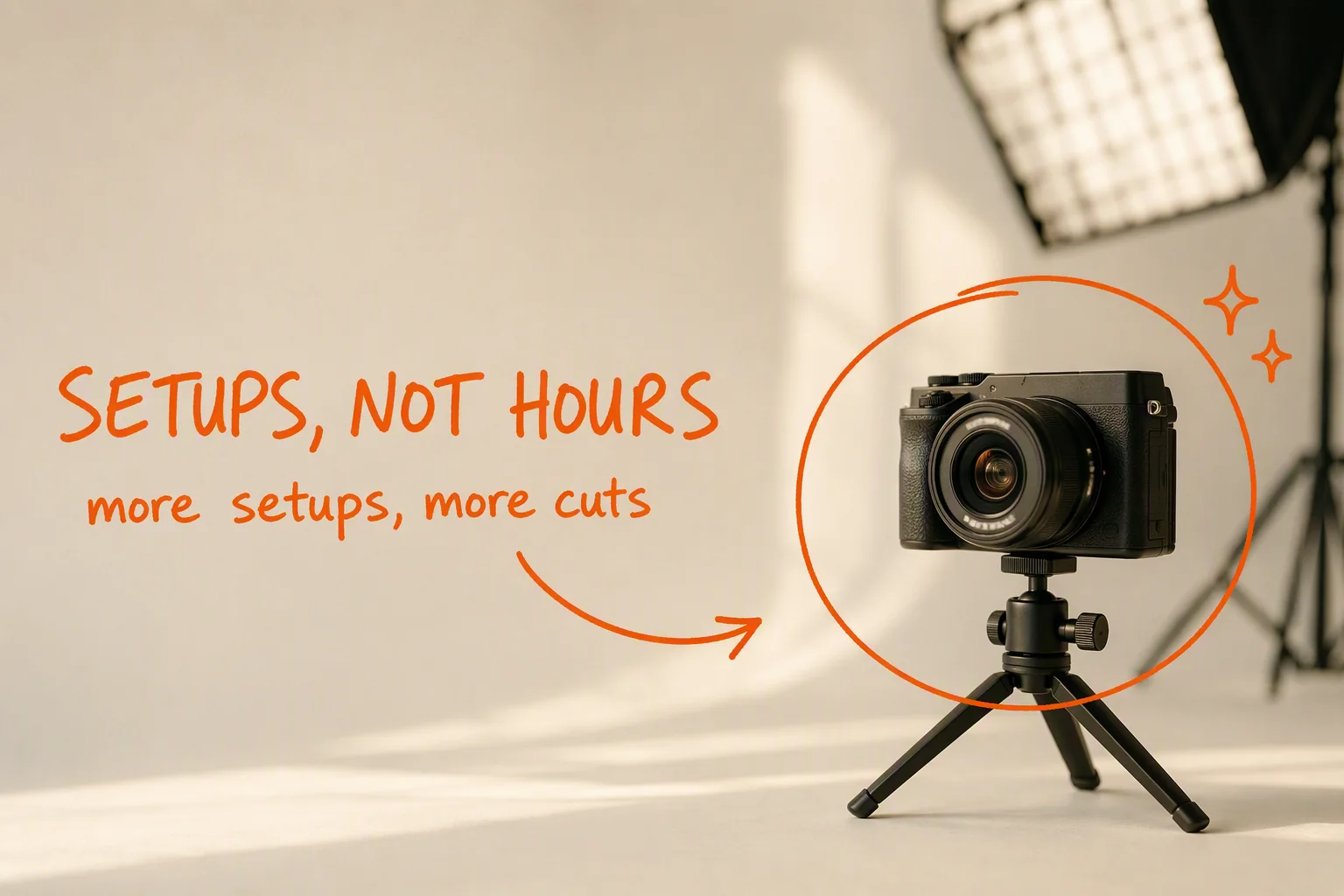
Our model is built on a simple piece of arithmetic. On any shoot, a large share of the cost is spent before the first usable second is recorded: crew call time, load-in, lighting, sound check, hair and makeup, and the general friction of getting a room ready. That cost is paid once per day, not once per video. So the difference between filming one thing and filming twelve things in a session is nothing like a twelve times difference in price.
What a batch day looks like
We plan two or three lighting and framing setups that we can return to all day, then work through a shot list built from the content plan rather than invented on the morning. Wardrobe changes and background changes do the work of making the output look like it came from different days. The aim is a session that ends with several weeks of material, already sorted, rather than one finished video and a card full of footage nobody will revisit.
Why repeatable formats beat one-off concepts
A format we can shoot again cheaply is worth more than a clever concept that never returns. Repeatability is what keeps the second month from costing what the first month cost, and it is what lets a client build a publishing habit instead of commissioning a project every quarter. It is also, honestly, less exciting to present in a pitch, which is part of why it is undersold.
Where AI sits in this, and where it does not
We use AI where it genuinely saves time without anyone noticing it was used: transcription and rough assembly, subtitle generation, versioning to different aspect ratios, and first-pass variations of an on-screen headline. We do not use it to fabricate people, places or claims about a client, and we will tell you plainly which parts of a deliverable were generated. Anything that would be a surprise if the client found out later does not go in.
What we need from you
A shoot day works when the decisions were made before it. That means an approved shot list, one decision-maker who can say yes on the day without a committee, whoever is appearing on camera actually available for the hours booked, and access to the location arranged in advance. The most common cause of an over-running shoot is not the crew, it is a script still being edited at 10am.
How to brief a production company, and what to ask before signing
Here is the version we would give a friend, including the parts that do not favour us. A good brief is shorter than most people expect and answers four things: who the video is for, where it will be seen, what you want that person to do afterwards, and what has to be true for you to consider it a success. Everything else is production detail, and production detail is our job, not yours.
- Lead with distribution, not duration. Saying you need a two minute video is a guess at the answer. Saying it runs on the homepage, in a sales deck and as a paid ad on Instagram tells a production company what to make and how many cuts to price for.
- Ask who is actually on the shoot and in the edit. Pitch teams and delivery teams are frequently different people. That is not automatically bad, but you should know it, and it should be reflected in the price.
- Ask to see a project like yours, not the showreel. A showreel is the best two seconds of everything ever shot. A single complete project of a similar scale and budget tells you far more.
- Get the deliverable list in writing. Number of finished cuts, aspect ratios, subtitle languages, delivery format, revision rounds, and who holds the rushes afterwards. This list is where disputes live.
- Agree the approval chain before the shoot. Two named approvers is workable, five is a project that will miss its date. If your organisation genuinely needs five, say so upfront and it gets priced into the schedule rather than discovered in week six.
- Be suspicious of a quote with no assumptions listed. Every real quote rests on assumptions about days, locations, talent and revisions. A quote that states none of them is not simpler, it is less finished.
Where a bigger production house is the better choice
If you are still working out whether the priority is one strong film or a steady stream of content, that is a genuinely useful conversation to have before anyone quotes. Our studio overview sets out how the video, social and content work feed each other, which is usually the cheapest way to answer it.